Imambargahs, ghettoisation, and the spectral presence of the Hazara community
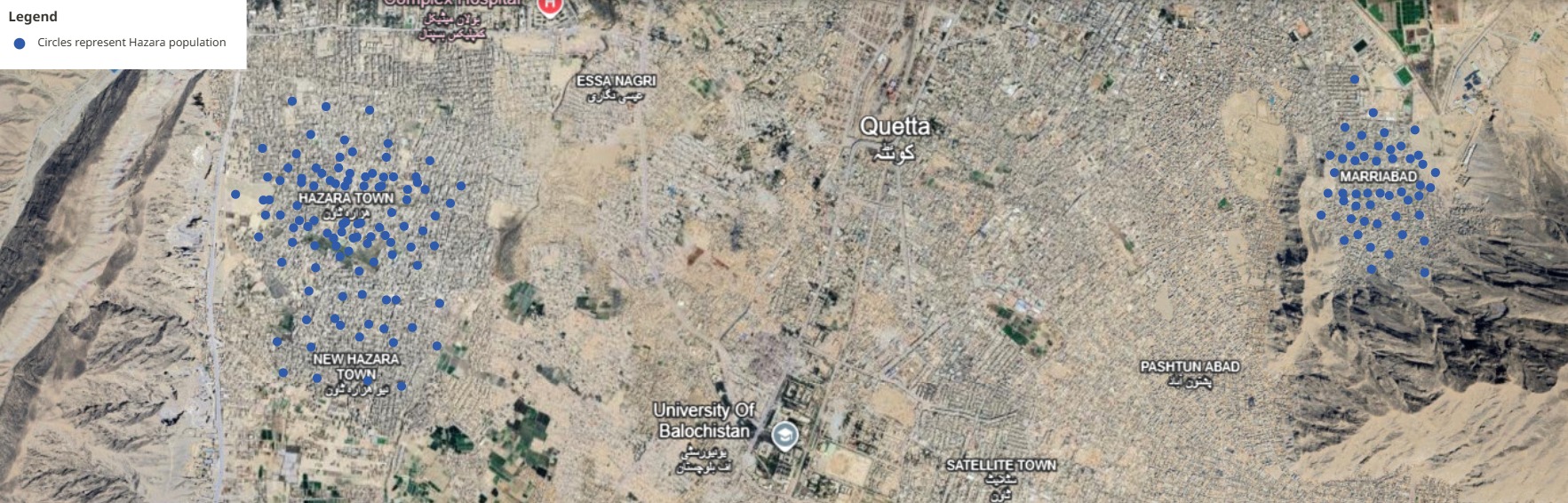
Click a location pin to explore the panoramas for that area.
Experience the spatial shift of the city during the mourning season through field recordings, ambient sound, and a visual procession of public reclaiming.
Research and Teaching Fellow at Habib University. Works on local knowledge and climate change, the political economy of development, and minority experience, with a focus on ethnographic method.
Social Development and Policy major at Habib University, Class of 2028. Combines spatial analysis with visual methods to trace how communities inscribe presence onto cities that have tried to make them invisible.
Third-year Computer Science student and Rights, Advocacy & Ethos (RAE) Chair at Habib University. Brings backend systems experience and frontend prototyping to research initiatives.
Final-year Social Development and Policy student at Habib University. Interests in human rights, minority and gender justice, education equity, and urban governance in Pakistan; qualitative and ethnographic methods.
Exact locations are not published. Sites are referenced by number only for community safety.
Experience the spatial shift of the city during the mourning season. Scroll to explore the progression of Ashura through field recordings, ambient sound, and a visual procession of public reclaiming.
Scroll down to begin. Ensure your sound is on.
Tracing Absence is a digital ethnography research project that investigates the spatial and everyday experiential dimensions of the Hazara community's enforced retreat from Quetta's urban centre. It emerges from fieldwork conducted across imambargahs in Mariabad, Hazara Town, and Quetta's mixed-neighborhood city centre, sites that hold, in their architecture, founding dates, and daily rhythms, the material record of a community's relationship to a city that has changed around them.
Through photographs, panoramic documentation, field annotations, sound, and spatial mapping, the project traces what remains visible of Hazara presence in parts of the city the community can no longer freely inhabit. It asks what imambargahs in mixed and Sunni-majority neighborhoods reveal about absence, not as emptiness, but as something felt, material, and spatially legible, and how the accessibility of these sites shifts between ordinary time and the mourning season of Muharram.
This research was conducted under the Summer Tehqiq Program (STRP) 2026, Habib University Karachi.
Desc